
Domestic hot water electrification for a technology campus
San Francisco Bay Area. Two heat pump modules instead of six. The existing tank kept. The room's own waste heat used as the heat source. A safety problem fixed and a planned cooling project avoided — at a third of the cost of the design every prior bidder proposed.
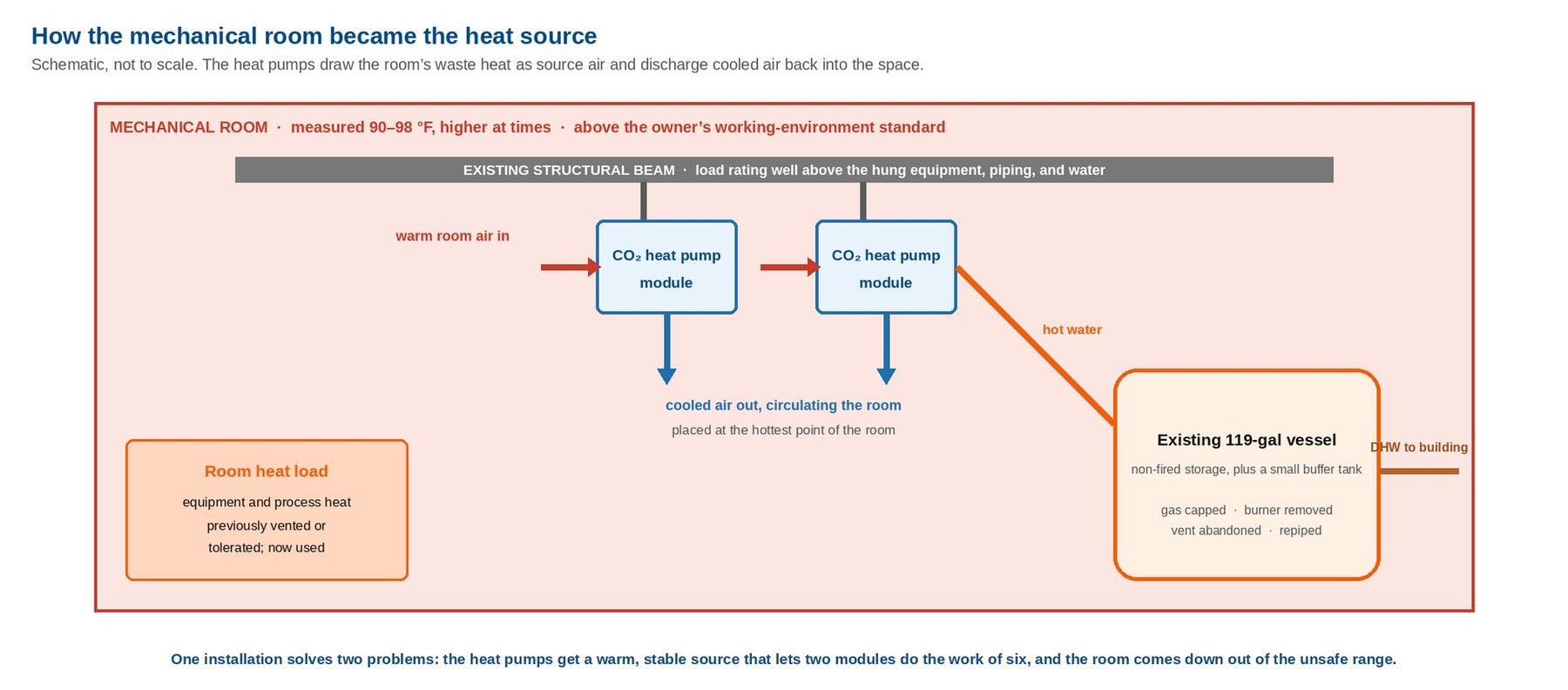
Two problems everyone else saw as one.
Every firm that looked at the job before EverWatt — including the heat pump manufacturer — proposed the same thing: six heat pump modules on the roof, several 2,000-gallon storage tanks lifted in by crane, and the existing gas water heater cut apart and hauled out of a mechanical room with a narrow access route. The price matched the scope.
EverWatt looked at it differently. The existing tank is nine years old and 95% efficient, so it stays and becomes storage. And the mechanical room runs at 90–98 °F — hotter than the owner's safety standard allows, with a cooling project already budgeted. That hot air is a better heat source than cold morning air on a roof. Two modules running on room air do the work of six outside, and the cooled air they discharge brings the room back into range. The heat that was a problem became the reason the design works.
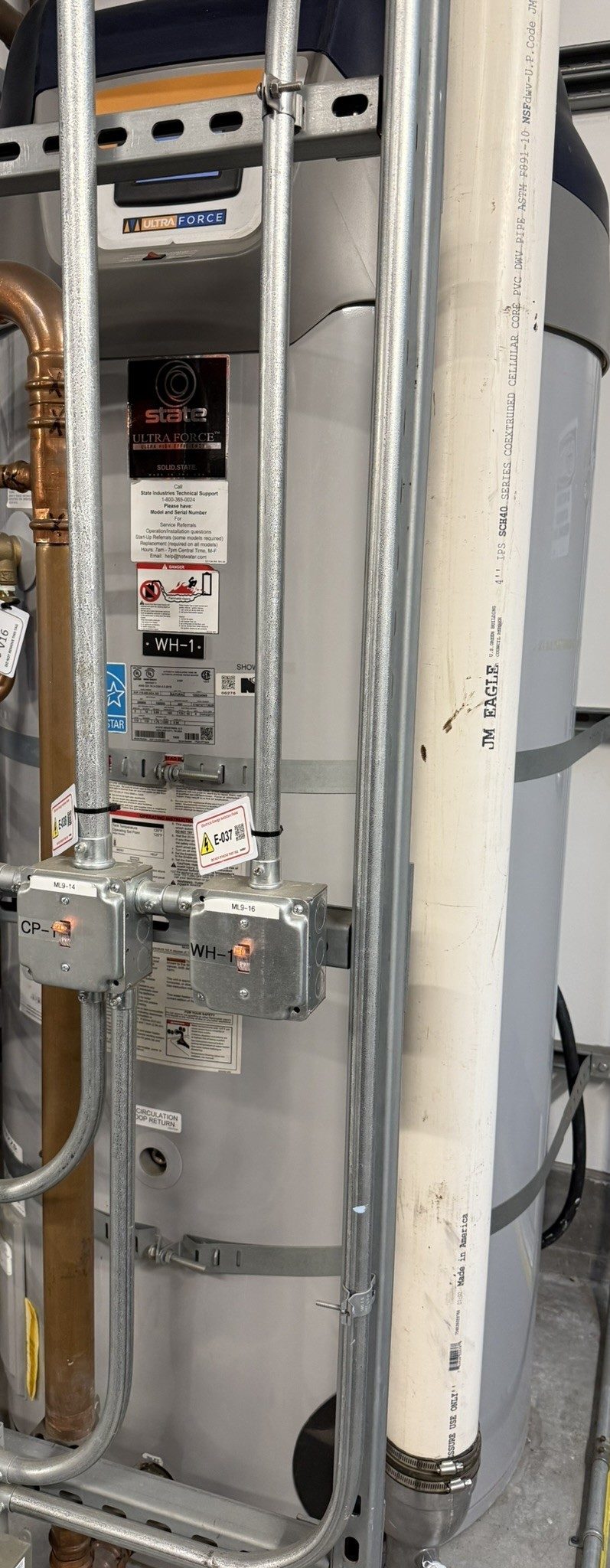
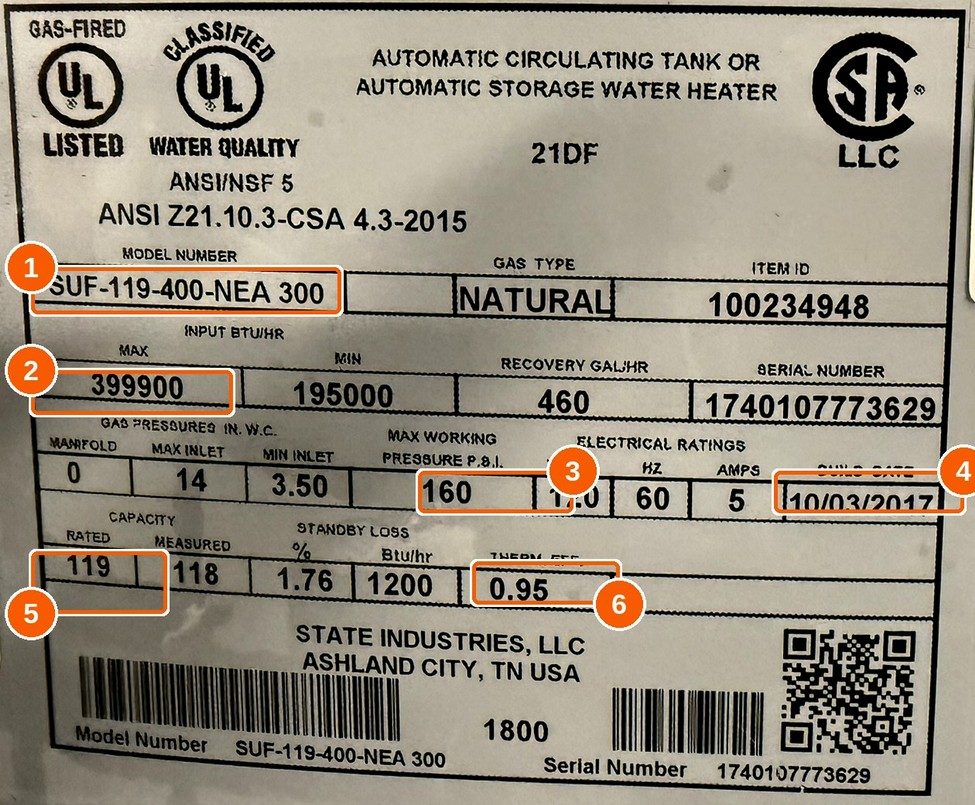
The existing heater and its nameplate. Every figure in the design traces back to it.
Two modules where the standard design needed six.
Warm air
A heat pump makes more hot water, and uses less electricity, when the air it pulls from is warm. On a roof it has to meet the morning load on the coldest day of the year. In a 90 °F room, each module produces more heat and the source stays steady all year.
Storage
The existing 119-gallon tank plus one small buffer tank let two modules run longer and catch up between peak draws — sized to the day's demand instead of the single busiest minute.
Margin
The standard design carried a spare module and tanks sized for a worst case this building never sees. EverWatt checked the room's heat balance, each module's output at room temperature, and storage recovery with the manufacturer's engineers before the design was accepted.
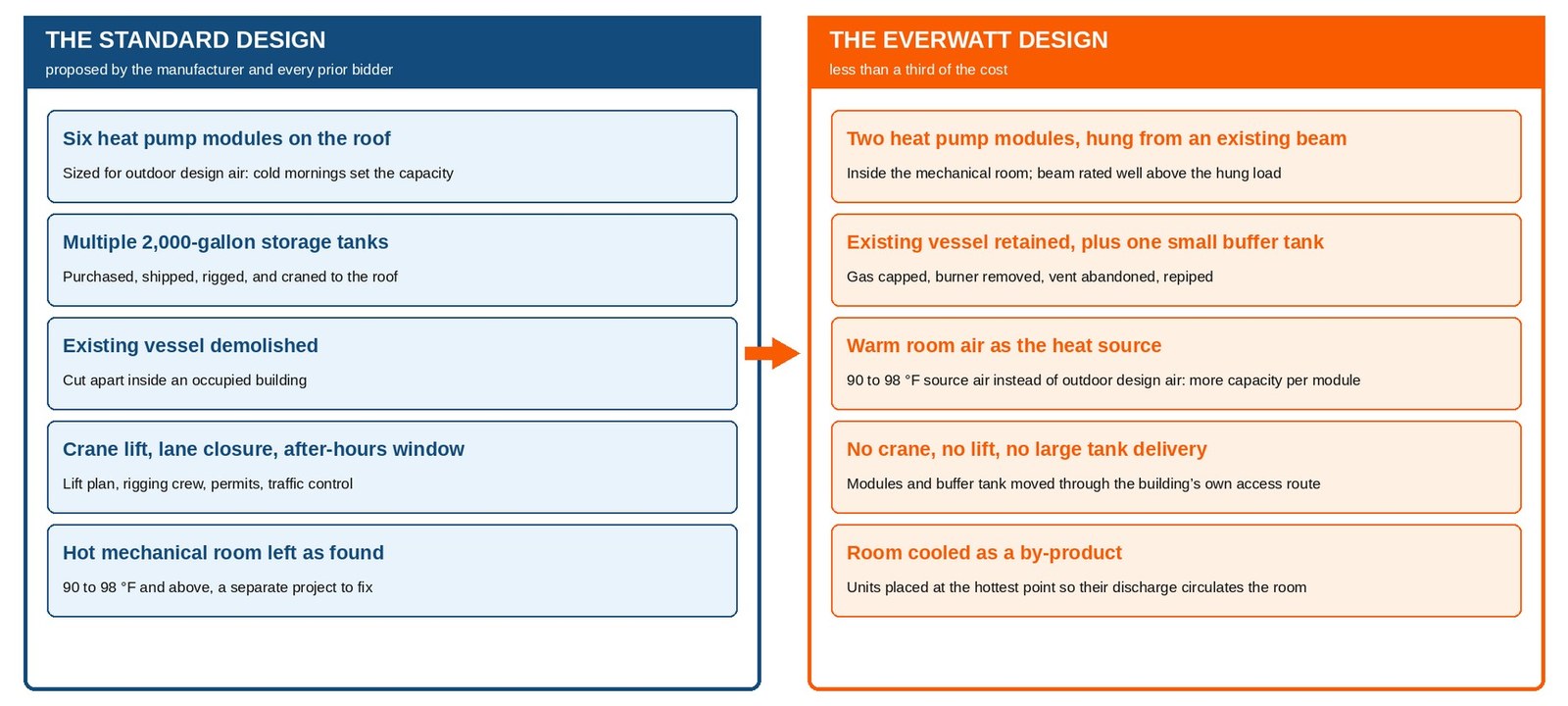
Left: what the manufacturer and every prior bidder proposed. Right: what was built.
Every measure traces to a finding in the survey.
| System | What the survey found | What EverWatt did |
|---|---|---|
| Existing water heater | Gas condensing unit, 399,900 BTUH input, 119 gallons, 0.95 thermal efficiency, built 2017, sound and in service. Too efficient to qualify under the deemed incentive path. | Retained as a non-fired storage vessel: gas capped, burner and ignition removed, vent abandoned, tank relabelled, all water connections kept. One small buffer tank added in place of the 2,000-gallon tanks. Measure documented and confirmed as a custom incentive. |
| Access and constructability | The vessel cannot leave the mechanical room intact; the standard design's 2,000-gallon tanks needed a crane lift, lift plan, permits, lane closure and an after-hours window. | No large tanks, so no lift. Two compact modules and one small buffer tank carried through the building's own access route. |
| The standard design | The manufacturer's application engineers, and every prior bidder, proposed six roof-mounted modules sized on outdoor design air, plus multiple 2,000-gallon storage tanks. | Two modules on a warm heat source. EverWatt took the design to the manufacturer's engineering staff, explained the source condition, and the design was accepted. Less than a third of the cost. |
| Mechanical room temperature | The room ran at 90–98 °F and higher, above the owner's standard for a working environment. The owner had a capital project planned to add cooling. | The heat pumps sit at the hottest point of the room and use its heat as source air; their discharge circulates cooled air through the space. One installation, two problems solved. |
| Location for the modules | No floor space in the room for heat pump equipment. | Modules hung from an existing structural beam rated well above the equipment, piping and water. A ceiling-mounted heat pump water heater installation no bidder had proposed. |
| Controls | Local gas controller; 125 °F setpoint; no integration. | Heat pump sequencing, tank temperature monitoring, pump staging, alarms, trending and BACnet integration with the building automation system. |
When the manufacturer says no, ask for their engineer.
Manufacturer review
The application desk rejected the two-module design because it judged against outdoor conditions. EverWatt asked for their engineers, showed them the room temperatures, the beam mounting and the tank reuse, and the design was accepted — a layout the manufacturer hadn't seen before.
Custom incentive pathway
At 95% efficiency the existing heater was too efficient for the standard incentive rules. EverWatt documented the permanent gas shutoff, the tank conversion and the heat pump performance basis, and the measure was approved as a custom incentive — settled with the program implementer before any equipment was bought.
Verified after startup
Room temperature and hot-water delivery are trended after startup to verify both outcomes. Developed to Investor Confidence Project protocols. Beam mounting under structural review and permit.
Told electrification is too expensive for your building?
Usually the catalog answer is. The engineered one often isn't. Send us the nameplate.
or call (510) 730-0062