
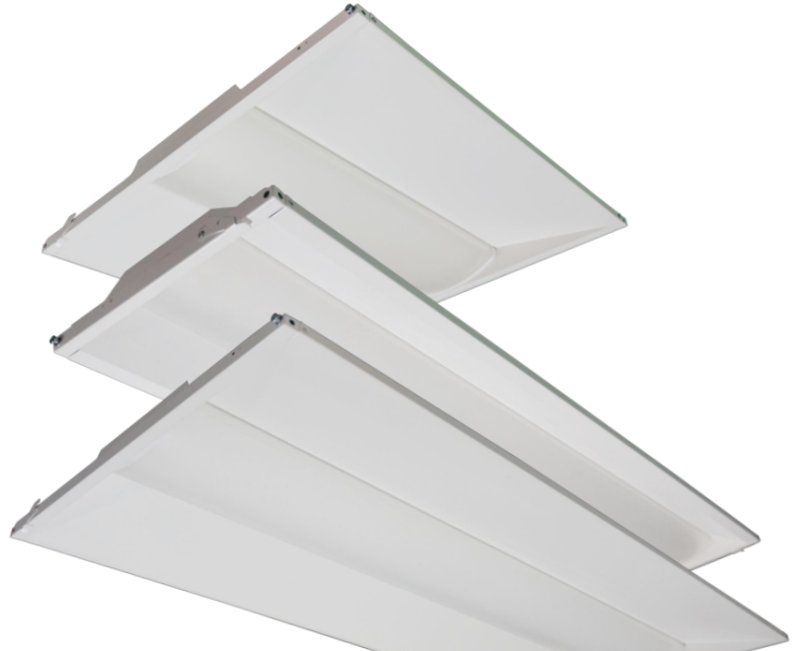
Most fluorescent troffer retrofits treat controls as an afterthought. The LED kit goes in, and if the building later wants occupancy sensors, an electrician is back on a ladder drilling holes and splicing wires, fixture by fixture. We redesigned our troffer retrofit kit so that never happens.
The problem we set out to fix
Adding a sensor to a typical retrofit kit is a small job repeated hundreds of times. Someone has to open the fixture, drill a hole for the sensor, run and splice the wiring, and close it back up. On our own projects, that came to roughly 30 to 60 minutes of labor per fixture.
On a 500-fixture building, that's 250 to 500 labor hours spent on sensor installation alone. Those hours are why many owners skip controls during a retrofit, even though controls are where much of the remaining savings is.
What we changed
Our first retrofit kit was a lay-in design built for hospitals, where crews work in tight ceilings around patient areas. It used quick-connect wiring harnesses so installers weren't splicing wires overhead. That idea became the foundation for the redesign.
In 2022 and 2023 we redesigned the kit around a hinged doorframe and made two key changes:
- A new mold with a built-in sensor port. The frame has a sensor knockout molded in, so there's nothing to drill.
- A pre-built wiring harness. The sensor connection is wired at the factory. In the field, a sensor plugs straight into the fixture.
The result: sensors can go in on day one or years later, without tools, without drilling and without an electrician rewiring the fixture.
Built for the people who maintain it
The same thinking runs through the rest of the kit:
- Factory pre-wired and labeled. Drivers and connections arrive wired and marked, which cuts installation errors.
- Quick-connect harness. Facilities staff can swap a component in seconds, without tools.
- Modular rail system. If one part fails, staff replace that part instead of the whole fixture.
- Field-adjustable brightness. Pre-labeled dimming leads let staff turn a fixture down on site when occupants say it's too bright.
- Hinged doorframe. The existing troffer housing stays in the ceiling. The kit installs into it and gives a clean, finished look.
One kit, set on site
Each kit lets the installer choose wattage and color temperature on site, so one product covers most spaces in a building.
| Spec | Range |
|---|---|
| Sizes | 1x4, 2x2, 2x4 |
| Wattage (selectable) | 14 W to 34 W, depending on size |
| Light output | About 2,030 to 4,930 lumens |
| Color temperature (selectable) | 3000K, 3500K, 4000K, 5000K, 6500K |
| Dimming | 0–10V, 100% down to 10% |
| Rated life | L70 over 100,000 hours |
Controls you can grow into
The kit works with the controls most buildings already use or plan to add. Autani sensors plug directly into the fixture's sensor port. Through third-party controllers and gateways, the kit also works with nLight, WattStopper and Lutron systems, Bluetooth mesh, and building management systems over BACnet. Emergency battery backup and demand response are available too.
So a building can start with basic dimming and add occupancy sensing, daylight control or a full networked system later, without replacing fixtures.
Hospital-grade driver
Many LED products aren't recommended for use with generators. Hospitals run on them during outages and tests, so we built the driver to handle it:
- Wide input range. Rated 120–277V, usable from 108 to 305V, to ride through generator fluctuations.
- Built-in protection. Over-voltage, over-current and over-temperature circuits shut the driver off safely under a fault.
- Independent reliability testing. Temperature cycling, humidity, accelerated life and thermal shock testing, with stable performance throughout.
Certified for rebates and code
The kit is ETL listed to UL 1598 and UL 8750 and listed on the DesignLights Consortium (DLC) Premium list. DLC listing is what most utility rebate programs look for, so the kit qualifies wherever rebates are available. It also meets California Title 24 JA8 and JA10 requirements, including flicker limits.
See it in your building
If your building still has fluorescent troffers, we'll audit them, show you the savings with and without controls, and find every rebate and financing option available. Talk to an engineer, or read more about our LED lighting and controls work.